California stands at a pivotal moment in math education.
The State Board of Education has adopted a new mathematics framework for kindergarten through grade twelve (K-12) that emphasizes equity, engagement, problem-solving, real-world relevance and technology integration. The framework highlights “Big Ideas” as overarching mathematical concepts that connect topics across grade levels, fostering depth, coherence and reasoning in mathematics.
A big change in how we teach math is desperately needed. In California, just over one-third of students met or exceeded state standards in 2025, with more disadvantaged student groups faring even worse.
But turning the vision of the new framework into reality requires more than policy documents. It requires new teaching methods, strategies and professional development proven to help students succeed.
We also need to break out of the old compartmentalized system where math sits in one box, computer science in another, and robotics in a third. In an era of rapid technology changes and the growth of artificial intelligence (AI), those rigid boundaries between disciplines have become increasingly irrelevant.
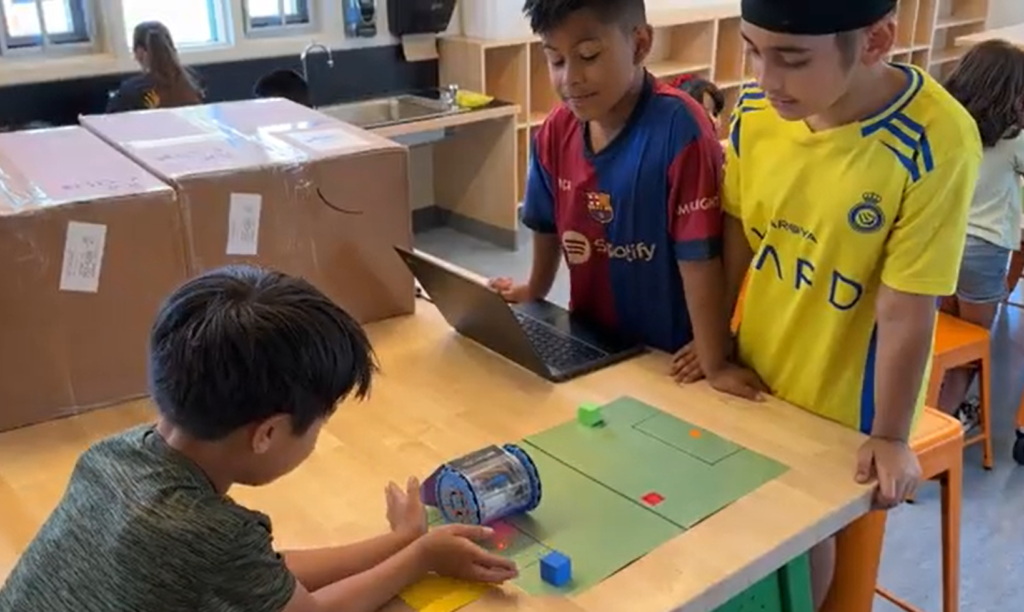
One integrated approach is to teach mathematics with coding and robotics. Today’s students have grown up in a digital world. Coding and robotics offer natural, engaging ways to connect math to their everyday experiences, making abstract concepts more tangible and intuitive.
And, because it is hands-on and allows students to program robots to explore real-world scenarios, this approach engages all students, including English learners, at-risk students, advanced learners, and special education students, while providing a pathway to deeper mathematical understanding.
Teaching mathematics with coding and robotics as an integrated learning experience for TK–12 students builds on more than two decades of research and development at the UC Davis C-STEM Center, in collaboration with industry partners and thousands of teachers and administrators.
The key elements of this integrated approach are: use coding to help students develop computational thinking and modeling within mathematics, with robotics as a bridge to engagement.
In modern science and engineering, computation, or the use of logical, step-by-step thinking to solve problems and model real-world situations, is regarded as a core skill alongside theory and experimentation. Increasingly, educators and researchers consider computational thinking foundational, on par with reading, writing and arithmetic.
Teachers can use guided and structured coding activities to help students explore algebraic structures, model real-world applications and develop problem-solving skills. Coding is more than a technical skill; it supports reasoning, modeling and understanding math concepts in context.
For students, robots provide hands-on, minds-on, collaborative learning experiences. Virtual or hardware robots allow students to see mathematical concepts in action, turning abstract ideas into tangible, real-world applications. Robotics combines principles from mechanical engineering, electrical engineering, computer science and artificial intelligence (AI) while serving as a powerful educational tool.
California now has the nation’s first comprehensive program to integrate mathematics with coding and robotics across grades TK–12, fully aligned with state math standards. Developed in collaboration with the UC Davis C-STEM Center, the curriculum maps each math standard to potential coding and robotics applications, and was approved for adoption by the California State Board of Education in 2025, in compliance with the new California Math Framework.
The guiding principle for integrating coding and robotics into math education is to do so only when it enhances student learning in mathematics. The curriculum empowers teachers with no prior coding or robotics experience to confidently guide their students, making math engaging, hands-on, and accessible.
Coding and robotics can actively engage students in exploring mathematical concepts through both virtual and physical robots across grade levels, from kindergarten through high school. Based on the coded instructions they provide, students can see virtual robots move on the screen and, when available, physical robots move simultaneously on an activity mat.
Pilot studies show that this integrated approach can help all learners, especially students who have struggled in traditional teaching and learning, make significant gains in math performance.
For example, in the Hacienda La Puente Unified School District, the percentage of students meeting or exceeding state math standards on the Smarter Balanced assessment rose from 16% in fifth grade to 71% in sixth grade after one year of instruction, a remarkable 344% improvement. In this cohort, 94% of students were Latino, and one special education student improved from “Not Met Standards” to “Exceeded Standards.”
While the curriculum, professional development, instructional strategies, and research results are well established, teaching mathematics with hands-on coding and robotics represents a fundamental paradigm shift in instructional practice. Early adoption of this integrated approach is often led by innovators willing to challenge traditional math instruction and the status quo, particularly in districts seeking innovative strategies to improve mathematics outcomes for all students.
The adoption of the new California Math Framework signals a bold commitment to reimagining mathematics education.Teaching mathematics with coding and robotics provides a clear, evidence-based model for bringing the framework’s vision into classrooms while engaging students and fostering critical thinking, problem-solving and teamwork in a technology-rich world.
This hands-on, integrated approach has the potential to transform math from a gatekeeper into a gateway for STEM opportunities for all students.
Read more By Harry H. Cheng
Harry H. Cheng is a professor of mechanical and aerospace engineering at the University of California Davis and director of the UC Davis C-STEM Center.